There have been more than a few conversations with my sons that made me stop and think, Wait — did I ever actually teach you that?
I am the mother of two sons, one a young adult and one a teenager, and over the years I have had countless everyday conversations with them and their friends. Sometimes the conversation is about money. Sometimes it is about work, school, driving, relationships, hygiene, online safety, or something as ordinary as how to send a professional email. And every so often, one of those conversations reveals a gap I did not know was there.
Not because they are incapable. Not because they are not paying attention. And not because teenagers today somehow know less than previous generations.
The problem is much simpler: adults often assume young people know things that no one has ever actually explained to them.
We call a lot of these things “common sense.” But common sense is often just information we have known for so long that we have forgotten someone once had to teach it to us.
That realization has changed the way I think about preparing teens for adulthood. I no longer think the goal is to make sure a teenager knows every possible thing before turning eighteen. That is impossible. The goal is to make sure they have a strong foundation of practical life skills, know how to find reliable information when they need it, recognize situations that require help, and feel confident enough to ask questions instead of pretending they understand.
That is what life skills for teens should really be about.
The Problem With Telling Teens They Will “Figure It Out”
There is a strange transition that happens during the teenage years. A child can spend years being told exactly what to do, when to do it, where to be, what to bring, and who is responsible for what. Then somewhere around middle school or high school, adults begin expecting that same child to remember deadlines, manage time, communicate professionally, understand money, make good decisions online, handle conflict, keep up with personal care, and gradually become more independent.
The expectations increase faster than the instruction.
We might say, “You should know better,” when the more useful question is, “Did anyone clearly explain what better looks like?”
Consider something simple like sending an email to a teacher. An adult sees a basic task: write a subject line, greet the person, explain the issue, ask the question, and sign your name. A teenager may be wondering whether “hey” is too casual, whether they need to include their class period, whether they are supposed to apologize for bothering the teacher, whether an emoji is okay, and whether “Sent from my iPhone” somehow makes the whole thing look ridiculous.
Or consider a first paycheck. An adult knows that gross pay and take-home pay are different. A teenager may calculate hours multiplied by hourly wage, wait for payday, and genuinely wonder where part of the money went.
These are not intelligence problems. They are information problems.
When we are intentional about teaching practical life skills for teenagers, we remove some of the unnecessary trial and error from growing up. Teens will still make mistakes. They should. Mistakes are part of becoming independent. But there is a difference between learning from a reasonable mistake and being blindsided because no one explained a basic concept.
What Counts as Life Skills for Teens?
When people hear “life skills,” they sometimes picture laundry, cooking, and balancing a checkbook. Those things matter, but the category is much bigger than household chores.
Essential life skills for teenagers include the skills that help a young person take care of themselves, manage responsibilities, communicate with other people, protect their money and identity, make safer decisions, handle increasing independence, and understand the systems they are beginning to interact with.
That means practical life skills for teens can include personal hygiene, food and sleep habits, time management, studying, organization, communication, boundaries, digital safety, scam awareness, budgeting, banking, debit and credit cards, saving, first jobs, paychecks, taxes, workplace behavior, laundry, grocery shopping, cooking, transportation, driving safety, basic civics, and knowing what personal information should be memorized versus protected.
It is a lot when you put it all in one paragraph.
That is exactly why “I will teach them eventually” can turn into “I assumed they already knew.”
The answer is not to sit a teenager down for a six-hour adulthood seminar. Most of us would not want to sit through that, either. The better approach is to teach these skills in context, revisit them as independence increases, and give teens something they can refer back to when they need it.
Personal Hygiene and Self-Care Are Learned Routines, Not Personality Traits
Personal hygiene is one of those topics adults often avoid because it can feel awkward. Unfortunately, avoiding it does not make the need disappear.
As children move through puberty, the routines that worked when they were eight may no longer be enough. Bodies change. Sweat changes. Skin changes. Hair changes. Menstruation may begin. Sports and activities add another layer. A teenager may need clearer guidance about bathing, deodorant, oral care, clean clothing, skin care, hair care, towels, bedding, and what to do after sweating heavily.
Saying “make sure you have good hygiene” is not particularly helpful if the young person does not know what a solid routine includes.
This is one area where I believe adults should be specific without being shaming. Hygiene should not be framed as “Do this so people will not think you are gross.” It should be framed as basic self-care: this is how you care for your body, stay comfortable, protect your health, and show up feeling prepared.
The same idea applies to sleep, food, hydration, medicine, and knowing when a health concern needs adult attention. Teens do not need to become their own doctors. They do need enough health literacy to know basic information about their bodies, medications, allergies, and safety.
Preparing teens for adulthood starts with helping them care for the person who is doing all the growing up.
Time Management Is More Than “Stop Procrastinating”
If you have ever asked a teenager why an assignment due tomorrow somehow became a surprise tonight, you already know why time management belongs on the list.
But telling a teen to “manage your time better” is about as useful as telling someone to “be more organized.” What does that actually mean?
Good time management involves knowing where deadlines live, estimating how long tasks take, working backward from due dates, breaking large projects into smaller actions, and deciding what needs attention first.
A student with a test tomorrow and a project due next week does not need a lecture about responsibility. They need a way to look at both obligations and decide what to do tonight.
This is also where adults need to be careful not to confuse productivity with maturity. Teenagers are not small employees who need every hour optimized. They need downtime, hobbies, friends, sleep, and room to be young. The goal is not to create a color-coded scheduling machine. The goal is to prevent responsibilities from constantly turning into emergencies.
One of the most useful independence skills for teens is simply learning to look ahead.
“What is coming this week?” is a much better habit than “What is due tomorrow?”
Communication Skills Matter Long Before a Teen Gets a Career
A surprising amount of adult life comes down to being able to communicate clearly.
Can you ask a teacher for clarification without sounding demanding? Can you tell a coach you are going to miss practice? Can you disagree with someone without turning the conversation into a personal attack? Can you ask a question when you do not understand something? Can you make a phone call when texting is not an option? Can you speak to a manager, receptionist, cashier, counselor, or other adult respectfully without becoming so nervous that you forget why you called?
These are everyday communication skills, and they are learnable.
Teenagers also need practice with self-advocacy. Speaking up for yourself does not mean being rude, argumentative, or unwilling to accept an answer you dislike. It means being able to explain a concern, ask a reasonable question, request clarification, and communicate what you need.
The teenage years are a good time to start shifting some communication responsibilities from parent to teen when appropriate. A parent does not need to disappear from the process. Sometimes the parent’s role simply changes from “I will handle this for you” to “Let’s talk about what you should say, and then you can handle the part you are ready to handle.”
That gradual transfer is a big part of preparing teenagers for adulthood.
Money Skills Need to Start Before the Money Gets Complicated
Financial literacy for teens should begin before a young person has a full-time job, a credit score, a car loan, or a stack of monthly bills.
The basics are enough to start: money coming in, money going out, needs versus wants, saving, banking, debit cards, credit cards, borrowing, interest, paychecks, taxes, and scams.
One of the simplest examples is the difference between a debit card and a credit card. They may look almost identical when you pull them out of a wallet, but they are not doing the same thing. A debit card generally uses money from a bank account. A credit card involves borrowing money from the card issuer and paying it back according to the account terms.
That difference seems obvious after you have lived with it for years. It is not automatically obvious the first time someone gets a card.
Teen financial literacy also needs to address the emotional side of money. A young person should understand that having money available does not automatically mean it should be spent, a sale is not a savings victory if you did not need the item, and a payment that looks small can become expensive when repeated every month.
Then there is the first paycheck.
A teenager who expects hourly rate multiplied by hours worked to land directly in the bank account is going to have questions when taxes and withholding appear. That moment is a perfect opportunity to explain the difference between gross pay and net pay, what a pay stub shows, and why keeping basic employment records matters.
The point is not to turn a sixteen-year-old into a financial planner. The point is to make money less mysterious before the consequences become larger.
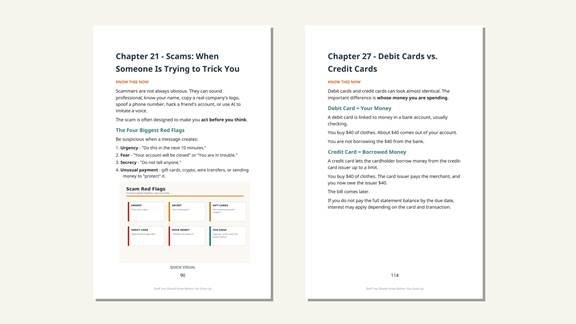
Money and digital-safety topics inside the guide
First Jobs Come With Their Own Set of Unwritten Rules
Getting a first job is exciting because it represents independence, money, responsibility, and usually at least a little freedom. It can also be confusing because workplaces have rules that adults rarely think to explain.
How early should you arrive? What does “business casual” actually mean? When is it okay to use your phone? What do you do if you are sick? How do you ask for time off? What if a customer is rude? What does a manager expect when they say, “Take initiative”?
Even the application process has its own hidden curriculum.
A teen may need help creating a professional email address, setting up voicemail, identifying references, writing a first résumé without much work experience, preparing for common interview questions, and researching a company before an interview.
First job tips for teenagers should also include something adults sometimes forget: knowing what not to accept.
A first job is not permission for an employer, coworker, or customer to ignore boundaries, demand unsafe behavior, harass someone, or pressure a young worker into situations that feel wrong. Teens need to know that workplace expectations and personal safety can exist at the same time.
Learning how to work is a life skill. Learning that you still have a voice at work is one too.
Digital Safety for Teens Is Now a Basic Life Skill
Older generations learned to watch for strangers, protect a wallet, and be careful about who came to the front door. Teenagers need all of that plus an entire digital layer.
Their phone may contain photos, messages, email, school accounts, payment apps, location information, social media, saved passwords, contacts, and enough personal information to make losing access to it a serious problem.
Digital safety for teens is no longer just “do not talk to strangers online.” It includes strong passwords, multifactor authentication, privacy settings, verification codes, phishing, fake accounts, job scams, gift-card scams, fake checks, hacked friends’ accounts, sextortion, cyberbullying, location sharing, AI-generated content, deepfakes, and knowing when a message is trying to create panic so the person reacts before thinking.
One lesson I want every teenager to understand is that a scam does not have to look ridiculous.
A scammer can sound professional. A fake message can use a familiar logo. A compromised social media account can make a request appear to come from a real friend. An urgent message can include a real name. Technology has made deception more polished.
That means the skill teens need is not simply “spot bad grammar.” They need to recognize patterns: urgency, secrecy, threats, unusual payment methods, requests for verification codes, promises that seem too good to be true, and instructions to move money or information quickly.
Teaching online safety for teenagers also means creating a home environment where admitting a mistake is safer than hiding it.
If a teen clicks something suspicious, sends money, shares a code, or becomes involved in an uncomfortable online situation, fear of being punished should not be the reason they wait three days to tell an adult.
Safety works better when the first instinct is, “I need help,” not “I need to hide this.”
Relationships, Boundaries, and Consent Are Practical Skills Too
We often separate relationship lessons from “real life skills,” but relationships are real life.
Teenagers need to know how healthy friendships feel, what peer pressure can look like, how to say no without writing a five-paragraph explanation, how to recognize controlling behavior, how to respect someone else’s boundaries, and what consent actually requires.
They also need to understand that conflict is not automatically a sign that a relationship is bad. People disagree. Friends get annoyed. Family members misunderstand each other. Dating relationships have uncomfortable conversations.
The skill is learning what to do next.
Can you address the issue without humiliating the other person? Can you listen long enough to understand what they are saying? Can you apologize without adding “but you…” to the end? Can you recognize when a disagreement has moved beyond normal conflict into intimidation, manipulation, threats, or control?
These are social skills teens will use in friendships, college, work, marriage, parenting, and every other relationship that comes later.
Everyday Independence Includes the Boring Stuff — and That Is the Point
There are some life skills no one is going to make into an inspirational graduation speech.
Laundry is one of them.
So is reading a care label, treating a stain before it goes through the dryer, knowing not to overload a washing machine, understanding basic food safety, reading a recipe before starting, comparing prices at the grocery store, safely using a kitchen knife, knowing what to do if a pan catches fire, and understanding what dashboard lights or hazard lights are trying to tell you.
These things are ordinary. That is exactly why they matter.
Independence is built out of ordinary tasks done consistently.
A teenager does not need to run an entire household alone to begin learning household skills. They can learn to wash their own clothes, prepare several basic meals, help plan a grocery list, clean a bathroom correctly, keep track of their belongings, and understand the difference between cleaning something and moving the mess somewhere else.
Teen independence skills should grow in layers. A younger teen may be responsible for laundry and packing what they need for school. An older teen may be handling a job schedule, gas money, meals around activities, transportation, and more of their own communication.
The goal is not to rush childhood. The goal is to make adulthood less abrupt.
There Are Also Things Teens Should Simply Know
Not every useful piece of knowledge fits neatly under money, school, safety, or household skills.
There is value in knowing basic geography, the structure of government, how percentages work, common measurements, how to estimate a tip, what 24-hour time means, what information should be memorized, and what information should be protected.
No, a teenager does not need to memorize every fact on earth. None of us do. We carry computers in our pockets.
But there is still a difference between knowing how to look something up and having no foundation at all.
A young person should know enough about the world to recognize whether the answer they found makes sense.
That is an underrated part of practical education.
How Do You Teach Life Skills Without Turning Every Conversation Into a Lecture?
This is where good intentions can go sideways.
A parent notices a gap and suddenly every car ride becomes a seminar on adulthood. The teen’s eyes glaze over. The parent talks more because the teen looks disengaged. The teen disengages more because the parent is talking more. Everybody arrives home irritated.
Life skills are easier to teach when they are connected to something that is already happening.
If your teen gets their first bank account, that is the time to talk about debit cards, account balances, fraud, and overdrafts. If they are applying for a job, that is the time to talk about résumés, voicemail, interviews, availability, and workplace expectations. If they receive a suspicious text, use the actual text to talk through scam red flags. If they want to cook something, let the recipe become the lesson in measuring, food safety, and kitchen cleanup.
The other part is letting them do some of it.
It is faster to write the email for them. It is faster to make the phone call. It is faster to fix the application. It is faster to handle every conversation with another adult.
But independence requires practice before independence is required.
That does not mean throwing teens into situations they are not ready to handle. It means giving them an appropriate amount of responsibility with support nearby.
Sometimes the most useful sentence a parent can say is, “I will help you figure out what to say, but I want you to try saying it.”
A Quick-Reference Approach Can Work Better Than Expecting Teens to Remember Everything
One of the biggest mistakes we make with practical knowledge is assuming that because something was explained once, it has been permanently learned.
Adults do not operate that way. We look up recipes we have made before. We search how to remove a stain. We check tax instructions. We read assembly directions. We Google what a dashboard symbol means. We keep notes, calendars, checklists, saved emails, bookmarked websites, and reminders.
Why would we expect a teenager to hear something once at fourteen and recall it perfectly at seventeen?
That is why I like the idea of a quick-reference guide for teens. It acknowledges that learning is not always “memorize this now.” Sometimes learning is “know that this information exists and know where to find it when you need it.”
A practical guide can sit on a shelf, live on a tablet, or be pulled up on a phone when a teen suddenly needs to know how to prepare for an interview, identify a scam, send an email, read a paycheck, wash a new piece of clothing, or respond in an emergency.
That kind of resource is not a replacement for parents, teachers, counselors, coaches, or real conversations. It supports those conversations.
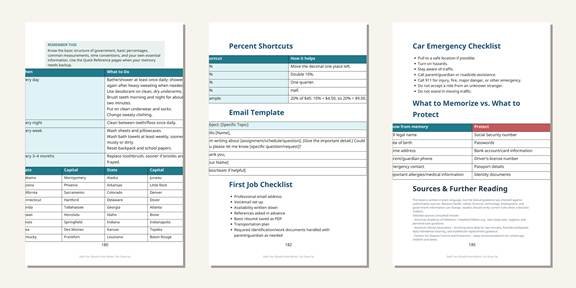
Quick-reference pages designed for practical, everyday use
Why I Created Stuff You Should Know Before You Grow Up
The more conversations I had with my sons and the young people around them, the more I noticed the same pattern: there were gaps between what adults assumed young people knew and what had actually been explained.
Sometimes I caught myself making the assumption too.
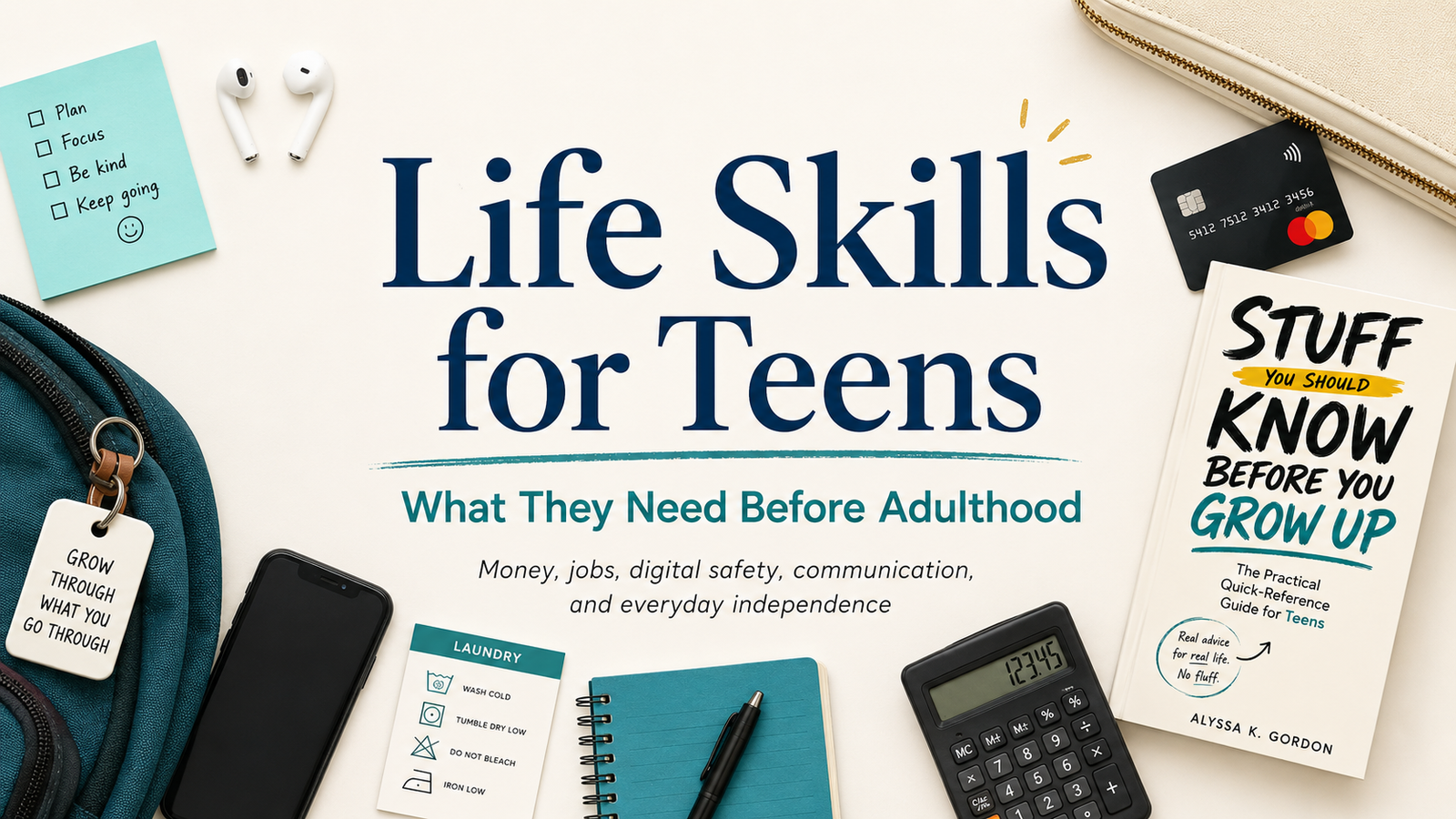
That is what eventually led me to create Stuff You Should Know Before You Grow Up: The Practical Quick-Reference Guide for Teens.
I did not want to create a book that simply named a topic and moved on. “Learn how to budget.” “Practice good hygiene.” “Be careful online.” “Communicate well.” Those statements sound useful, but they still leave the teenager responsible for figuring out what the advice actually means.
I wanted something more practical — a book that explains the terms, gives examples, points out common mistakes, shows what the situation can look like in real life, and gives enough guidance for a teen to know what to do next.
The book covers the kinds of things that become increasingly important as teenagers gain independence: personal care, school and organization, communication, friendships and relationships, digital safety, money, first jobs, workplace expectations, cooking, laundry, transportation, basic civics, and quick-reference information they can return to later.
Most importantly, I wanted the tone to sound like a real person talking to them.
Teenagers are old enough to recognize when something sounds like a lecture written for a hypothetical teenager instead of an actual one.
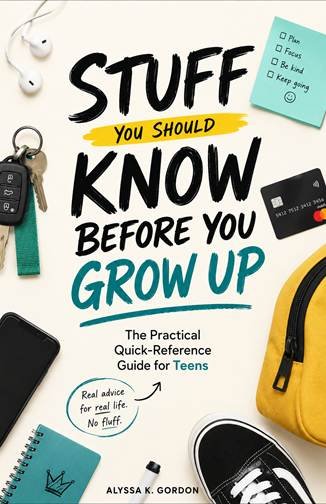
Stuff You Should Know Before You Grow Up by Alyssa K. Gordon
https://nexa71.com/product/stuff-you-should-know-before-you-grow-up/
The Goal Is Not to Raise a Teen Who Never Needs Help
Sometimes “preparing teens for adulthood” gets framed as producing a completely self-sufficient eighteen-year-old who never needs to call home.
I do not think that is the goal.
Adults ask for help. Adults call their parents. Adults ask friends how something works. Adults hire professionals. Adults read instructions. Adults make mistakes and try again.
The better goal is to raise a young person who knows enough to participate in their own life.
They can ask an informed question. They can recognize when something seems wrong. They can take care of basic responsibilities. They can communicate. They can protect themselves online. They can understand the beginning of how money works. They can solve smaller problems without immediately handing them to someone else. And when the problem is bigger than what they can handle, they know that asking for help is part of being responsible, not evidence that they have failed.
That is what practical life skills give teenagers: not perfect independence, but growing competence.
Start With the Things Your Teen Actually Needs Next
If the list of essential life skills for teens feels overwhelming, do not try to teach everything this month.
Look at the life your teenager is living right now and what is coming next.
Are they starting high school? Organization, studying, communication, online judgment, and time management may be the priority.
Are they looking for a first job? Focus on applications, résumés, interviews, professional communication, paychecks, banking, and workplace behavior.
Are they learning to drive? Add passenger safety, distracted driving, gas, basic car awareness, emergencies, and what to do after a problem.
Are they beginning to spend more time away from home? Talk about boundaries, safety, money, transportation, and handling unexpected situations.
Then keep adding layers.
Growing up is not one giant lesson. It is hundreds of smaller lessons delivered over time.
The best thing we can do is stop assuming those lessons will somehow teach themselves.
If you have ever had a conversation with a teenager and thought, “Wait, you did not know that?” you are probably seeing the same gap I did.
Instead of being frustrated by the gap, we can fill it.
And sometimes all it takes is one clear explanation, one real-life example, and one resource they know they can come back to when they need it.
Leave a Reply
You must be logged in to post a comment.